Plotting With Pictographs

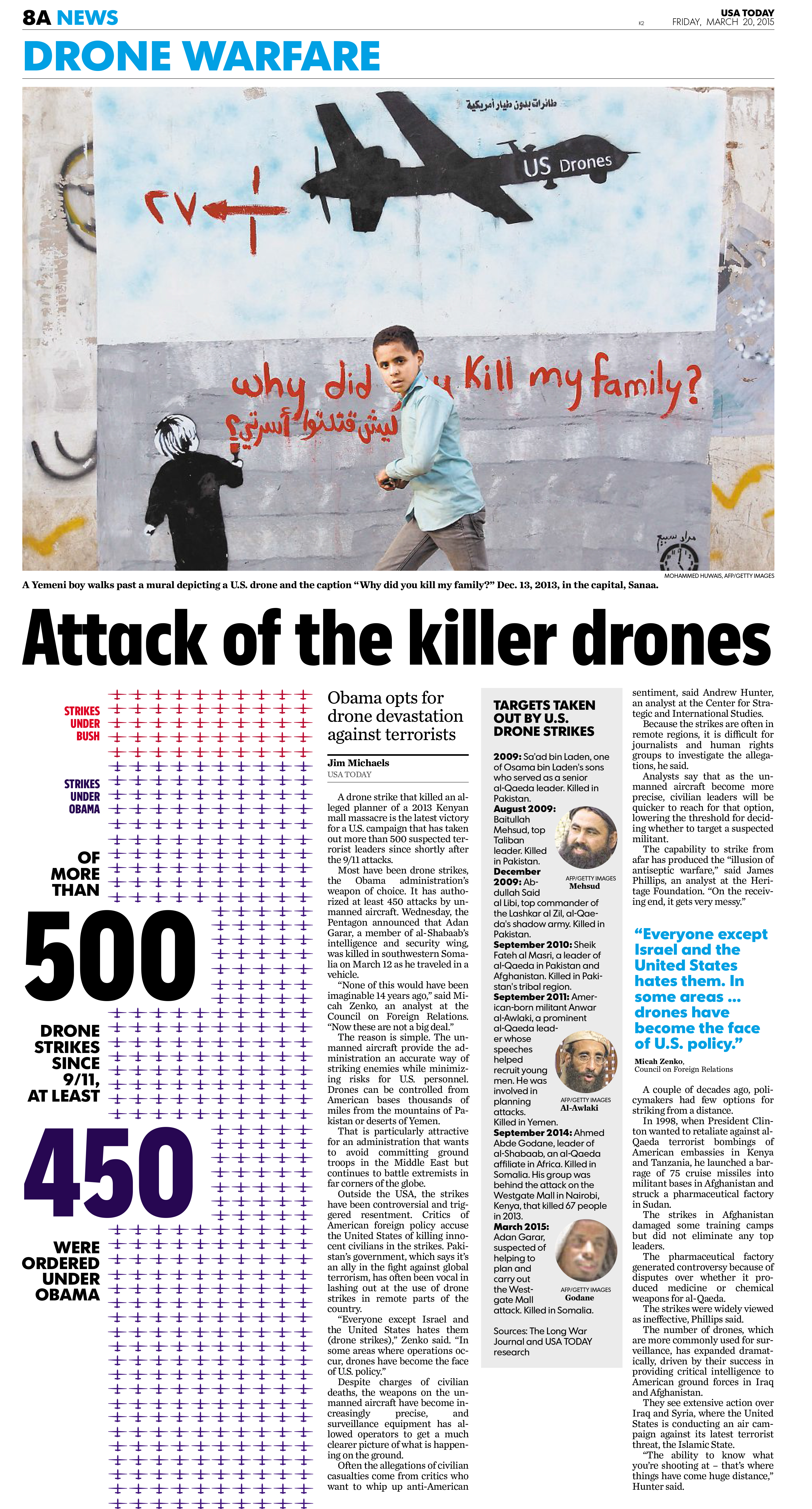
I used a pictograph to display the number of U.S. drone strikes in foreign countries as a quick fix for a display page that had only one photo.

USABrd_USAEast_1_03-20-2015_K2_BON_B_A_008_4_204152.ps

The numbers were taken from the story and I color-coded them to emphasize the story’s point, that more strikes were ordered by the Obama administration than during the Bush presidency.

Posted in Graphics | Leave a comment

A Passion for Organization

The new version.

The new version.

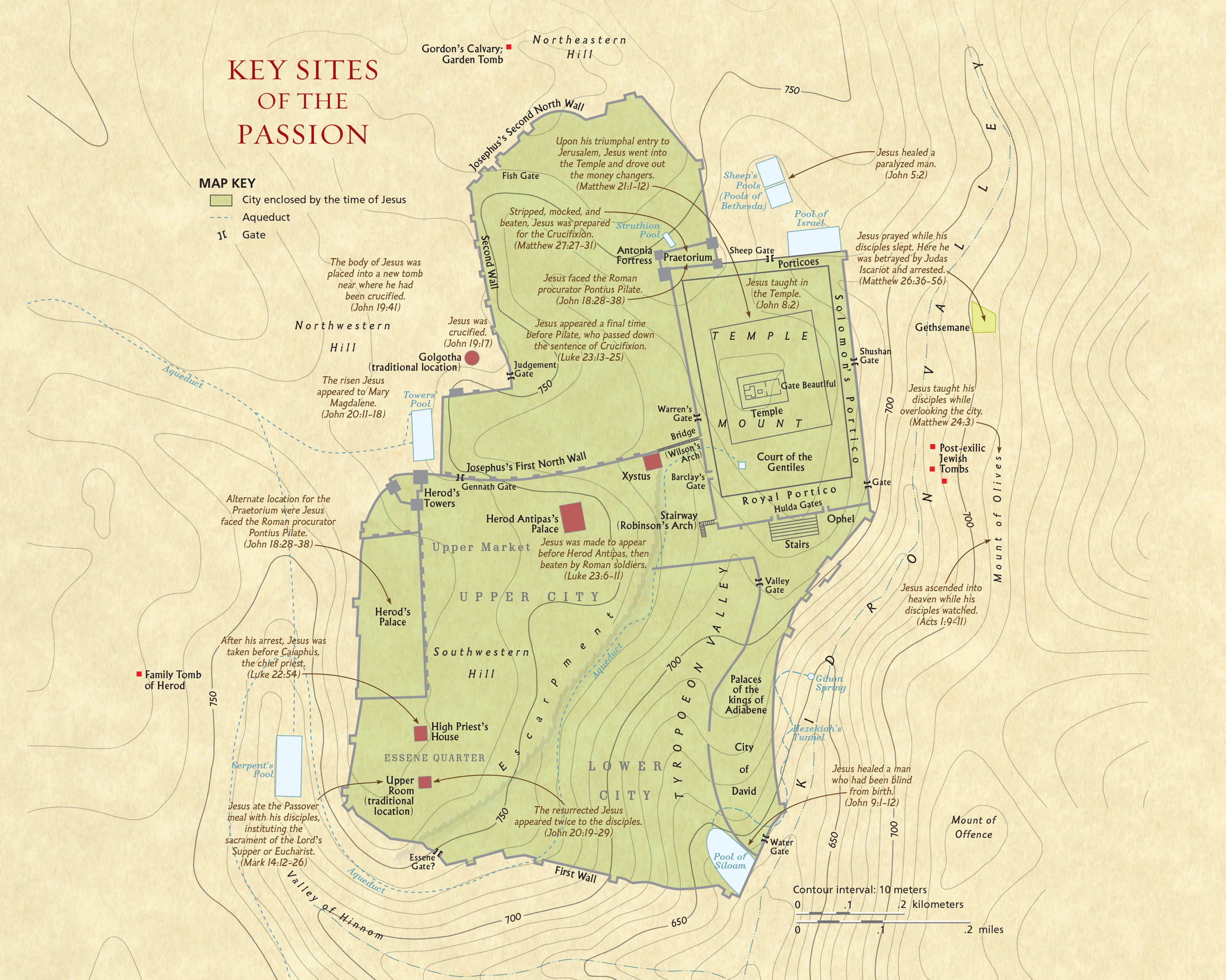
I took the initiative to rework a map in a recent USA Today/National Geographic Channel 40-page tabloid that promoted “Killing Jesus,” a NatGeo movie about the last week of Christ. I volunteered to design and paginate the tab.

The map was titled “Key Sites of the Passion,” and showed Christ’s locations in Jerusalem from his arrival in the city on Palm Sunday to his crucifixion and resurrection. I used additional text and reorganization to help the reader better follow Christ’s path.

As with stories, graphics can’t waste the reader’s time. If it’s not immediately understandable, readers will bypass it. I determine a graphic’s benefit by asking:

Do we clearly state what’s being shown?
Do we give readers an easy path through the graphic?
Are we using terms that are universally understood?
Are we presenting too much, or too little, detail?

The original version (see below) fails on three of these points. There’s certainly no easy path through the map, no hierarchy of events. It’s pretty much a random cluster of 18 text blocks with arrows indicating where events took place.

I took the 18 text blocks and organized them chronologically. Each block is drawn from a specific Bible chapter and verse, most from the Gospels of Matthew, Mark, Luke and John in the New Testament. (One block was from Acts.)

Then I checked each text block against two Bibles – the Standard Revised and King James versions. I eliminated three of the text blocks from John because they took place before Palm Sunday.

This established a logical narration, which I broke into four parts: Arrival; Arrest and Trial; Crucifixion; and Resurrection. The research also helped me find a spelling error – the chief priest is Caiaphas, not Caiaphus, and Luke 23:6-11 says the soldiers were mocking Christ, not beating him.

I tried using arrows to connect the text to the map site, but it proved complicated and distracting – too many lines criss-crossing the map. I used colored bulleted numbers instead, inserting them next to the text and on the map.

This changed the character of the graphic. Instead of the map being the focus, with bits of text scattered about, the narration became dominant, with the map as a vital, supporting player. I think it better serves the reader.

The original version.

The original version.

Posted in Graphics | Leave a comment

Small Bits of Context

I think history is important, and anything that helps us understand it is vital. Looking through stories for USA Today’s D-Day tabloid I designed and paginated, I saw several information gaps that could be filled in to help readers better comprehend the story.

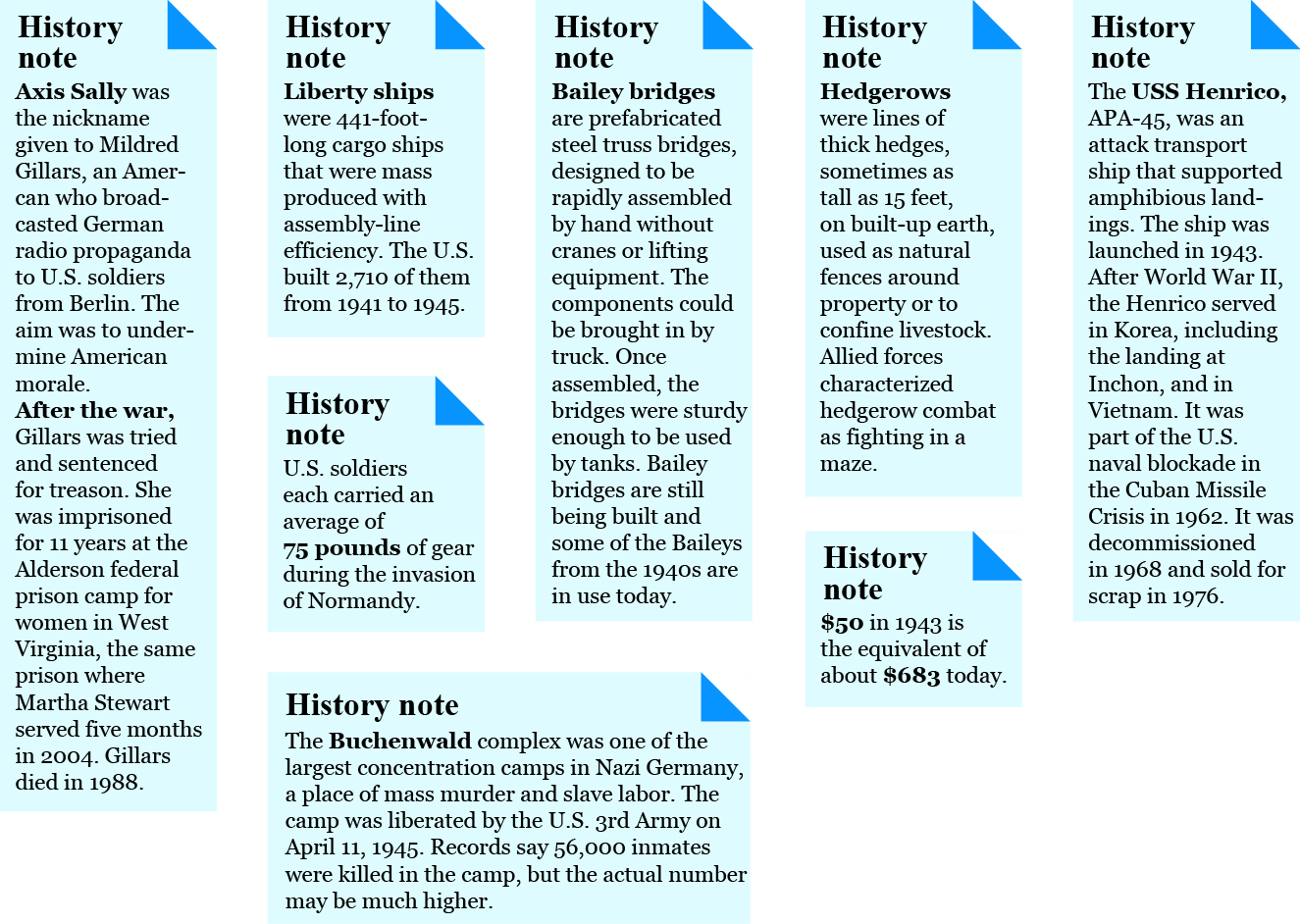
I came up with the idea of giving stories history notes — small boxes with facts relating to specific stories. I researched and wrote 15 notes and strategically placed them throughout the publication, one note per page. A few are below:
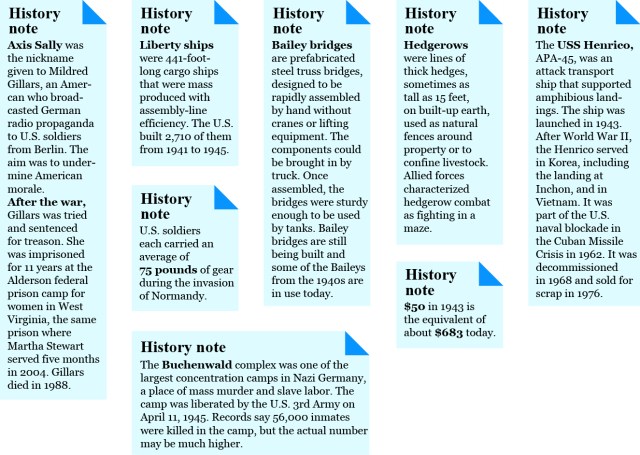
Some of the history notes that ran in the D-Day tab.

Some of the history notes that ran in the D-Day tab.

A brief aside: The germ of the idea came from the writer Harlan Ellison. I’m a big fan of his, and in one of his college lectures he mentions being questioned by an audience member:

“I usually get most of your references,” she says, “but who was that last one? Dock-something?”

“Dachau?” Ellison says. “You mean Dachau?”

“Yes,” she says, “who’s that?

I thought of that exchange while reading a tab story about a soldier who was part of the liberation of Buchenwald. Just as a test, I asked several people in the office — younger, college-educated professionals — if they knew what Buchenwald was. They didn’t.
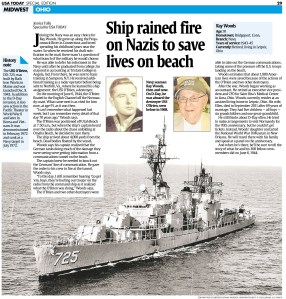
History notes were inserted into the margins of tab stories.

History notes were inserted into page margins.

The story identified Buchenwald as the infamous slave-labor camp but my added note described it and included the day of liberation and estimated number of deaths. It made Buchenwald harder to forget or overlook, I hope.

After that, I started looking for other note opportunities. Some were purely for points of reference: the value of $50 in 1943, adjusted for inflation today, was one. Bailey bridges were fascinating marvels of simple engineering.

Another was about hedgerows and what a nightmare they were in combat throughout northern France. Hedgerows weren’t the decorative hedges in front of your house, in other words.

Others were U.S. Navy ships mentioned in stories — whatever happened to those ships, I wondered.

Though each note was short and to the point, they gave readers a bit more information that put D-Day in perspective and gave a greater understanding of what it was all about.

Posted in Graphics | Leave a comment

Extra Effort

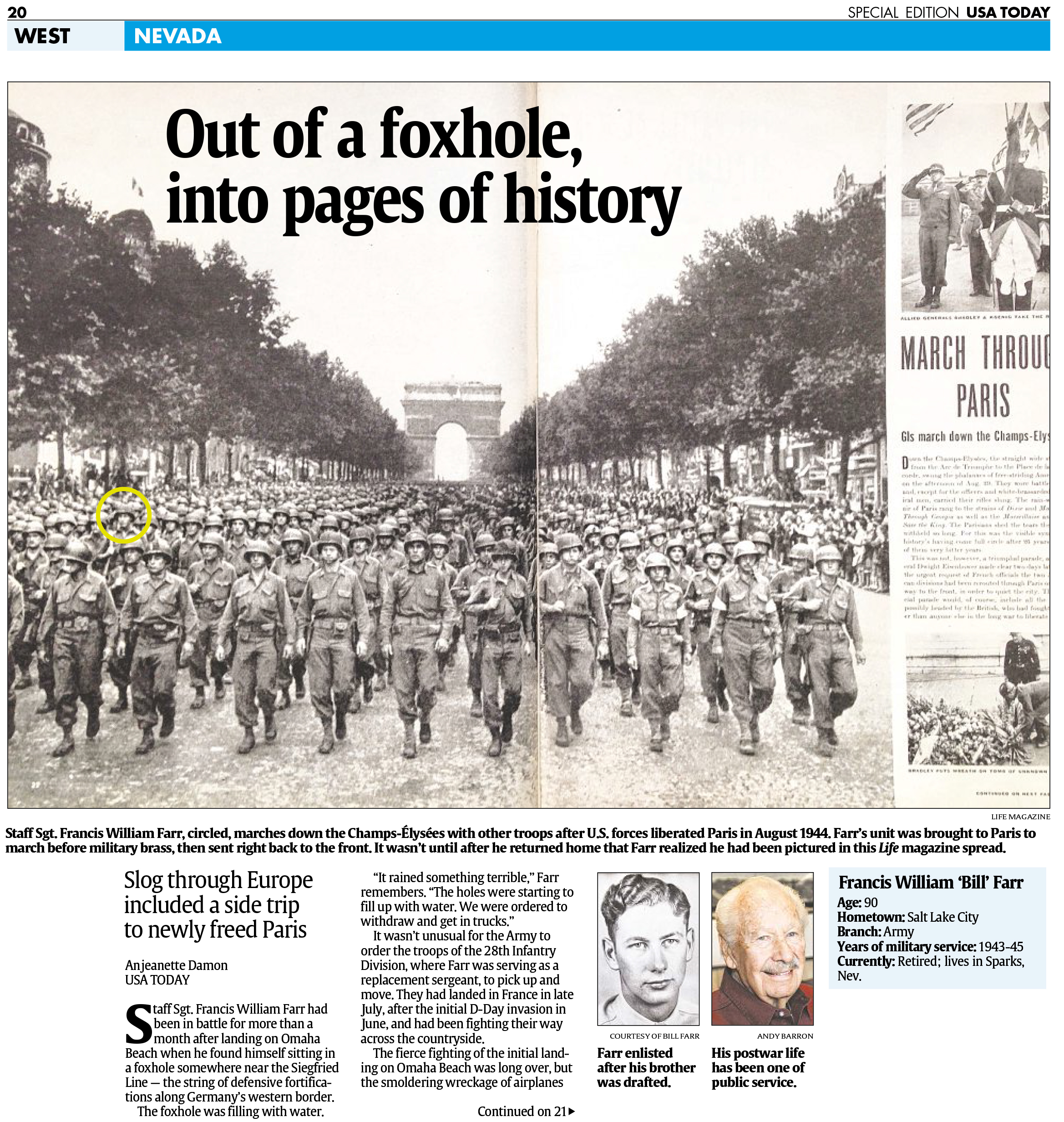
I drove 50 miles and spent $16 to find an old issue of Life magazine that figured prominently in a USA Today publication.

Life Magazine, Sept. 18, 1944

Life Magazine, Sept. 18, 1944

The story was about a soldier, Sgt. Francis Farr, who recognized himself in a Life magazine photo of American troops marching under the Arc de Triomphe in Paris at the end of World War II. The story was pretty good, but there was a problem: We didn’t have a copy of the Life photo.

Our photo guys tried to track one down but were unsuccessful. Mr. Farr didn’t have one. We didn’t even know the date of the Life issue, except for two clues: The march took place in August 1944 and Thomas E. Dewey was the cover photo on the Life issue with the picture. Our story cried out for that picture.

“C’mon,” I thought, “there has to be a way.”

My wife likes antique shops and I remembered seeing a room full of old copies of Life at a place called Black Shutter Antique Center in Leesburg, Va. I searched the Internet for the Life-Dewey connection and came up with a logical date: Sept. 18, 1944. I called the store but they had no idea if they had one.

“Maybe,” said the guy on the phone.

So I took a chance and drove to Leesburg on a day off and found it. I bought it and took it back to USAT where the double-truck spread was photographed and digitally reproduced.

We e-mailed a PDF to the reporter, who took it to Mr. Farr, who pointed himself out in the Arc de Triomphe picture. I masked off a yellow circle around Sgt. Farr, just enough to indicate him, cementing his place in both Life and USA Today. In retrospect, it was probably the best $16 I ever spent.


Posted in Pages | Leave a comment

Putting It in Perspective

RURAL.drive.11.11 copy

This map accompanied a story by Jayne O’Donnell on hospitals closing in rural areas of the U.S. It was a good story that called attention to lower-income people who are in danger of losing medical care, simply because their hospitals can’t stay in business. The hospitals, most in rural states, are closing in the aftermath of the Affordable Care Act because they’re losing Medicaid and Medicare reimbursements.

This map shows how residents of Stewart County, Ga., must travel extra miles to reach a neighboring hospital. In an emergency, that extra time can be critical.

Posted in Graphics | Leave a comment

Fun With Food

USATab_XTR_1_10-27-2014_0_6_B_Z_006_4_132744

This is a page from a USA Today publication on food. The art gave me the chance to play with the layout and typography a little, and the project ended up being fun.


Posted in Pages | Leave a comment

Details Matter

USATabXTR_XTR_5_05-19-2014_0_33_B_Z_033_4_180126

This was a page for USA Today’s D-Day publication, an anniversary observance about the Normandy invasion 70 years ago. Stories focused on veterans who participated in the invasion.

In this story, I noticed the picture of a woman attached to the rear wall of the truck and wondered who it was. The reporter contacted the veteran who said it was a poster of a movie actress, but he could not recall who the actress was.

I did some research but couldn’t discover her identity, either. Nevertheless, I noted the poster’s presence by telling what we knew of it in the cutline.


Posted in Pages | Leave a comment

Tracking the D-Day Invasion

d-day-tab1

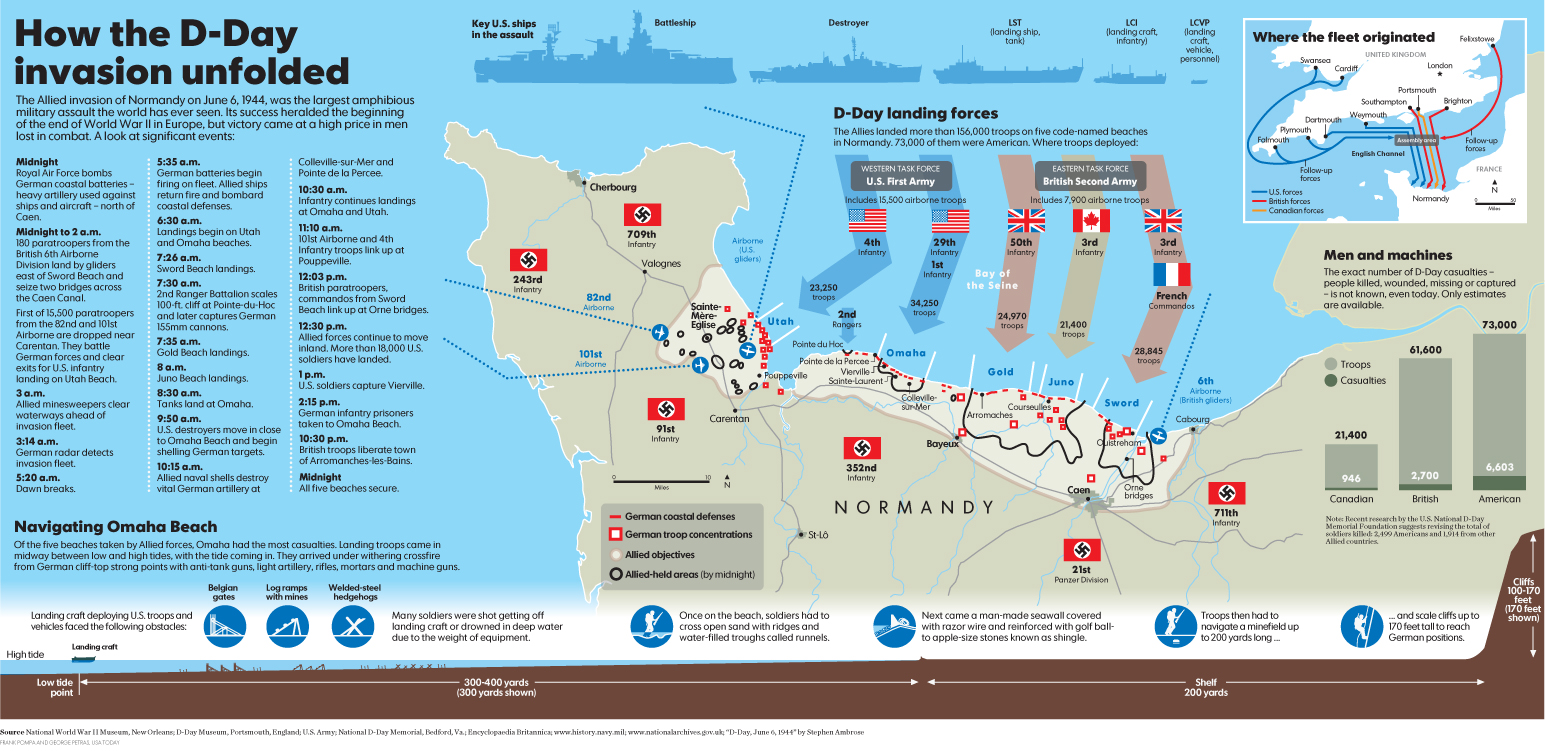
USA Today publishes a number of special tabloids focused on specific issues – the ones I’ve done include military and historical subjects. I volunteered for the 70th observation tab of the D-Day invasion, some pages of which you’ll see here.

This graphic, one I really wanted to do, shows the scope of the landing and what Allied forces faced. The Normandy coast was divided into five zones for the assault; I chose Omaha Beach as the example.

The American public perhaps knows Omaha best from the 1998 film Saving Private Ryan and other movies. (Everyone’s seen those welded steel girders called hedgehogs.) Omaha also had the highest casualties, because of its curved configuration and the alignment of German defenses. A cross-section of Omaha is shown, giving a sense of scale and the types of anti-personnel devices used. We also show strength of troops deployed, types of ships, and paratrooper drop zones. A timeline lists landings and describes how the day unfolded.

The graphic packs a lot of information into a double-page spread in the center of the tab. I did most of the research by getting a nearly a dozen books from the library and a score of military magazines and scouring the web.

Frank Pompa was the graphic artist and he did his usual wonderful job. He’s a history buff and his knowledge and attention to detail helped make the graphic perfect.

Posted in Graphics | Leave a comment

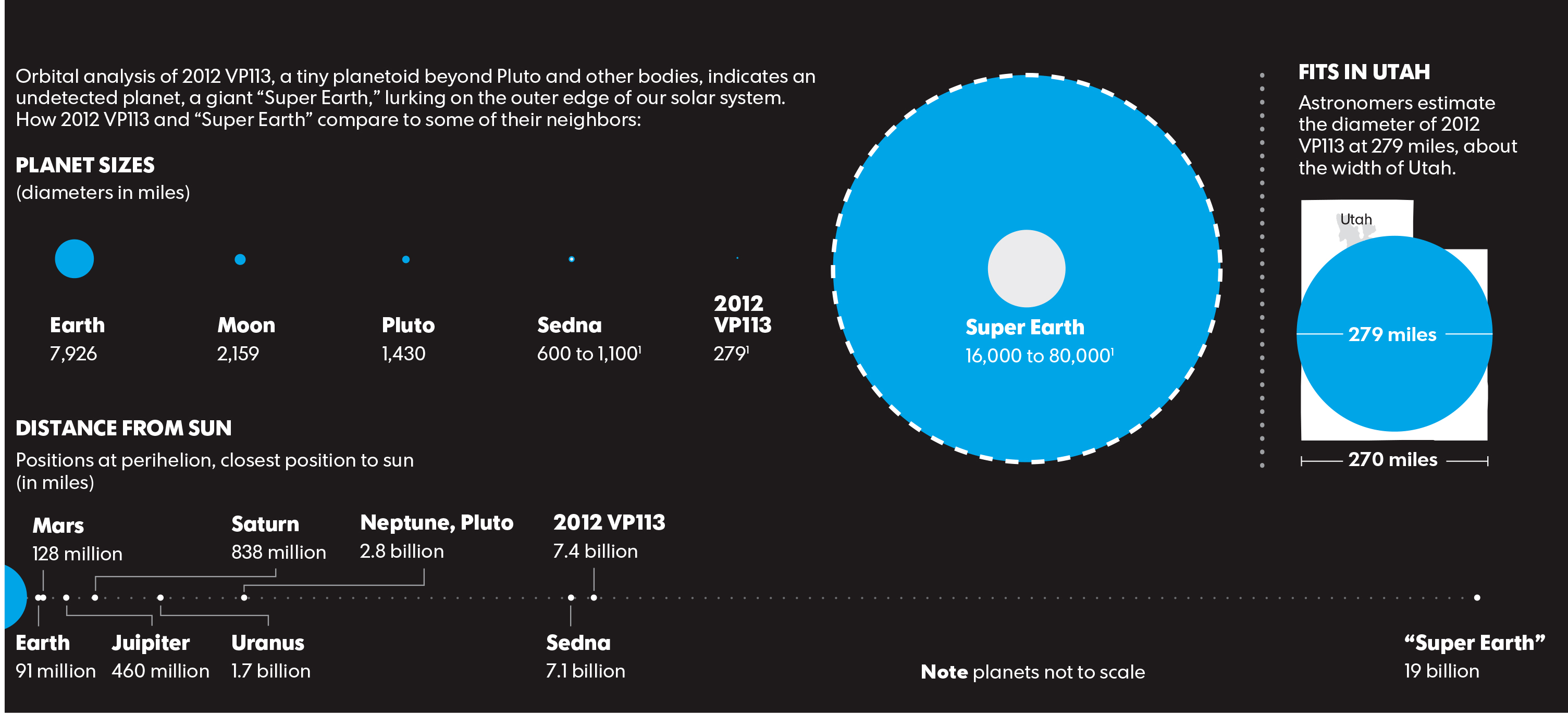
New Planets Discovered

dwarf_planet

This is a relatively simple graphic about newly discovered planets just beyond our solar system. The chart gives you an idea about the planet’s size by comparing it others in our solar system.

I did the research for this, using data from the story and other sources, and sketching a presentation that helped graphic artist Karl Gelles with the visual organization. I especially liked using Utah as a reference for the diameter of 2012 VP113.

This ran in print and as an interactive graphic online.

http://www.usatoday.com/story/tech/2014/03/26/rogue-planet-solar-system/6863655/

Posted in Graphics | Leave a comment

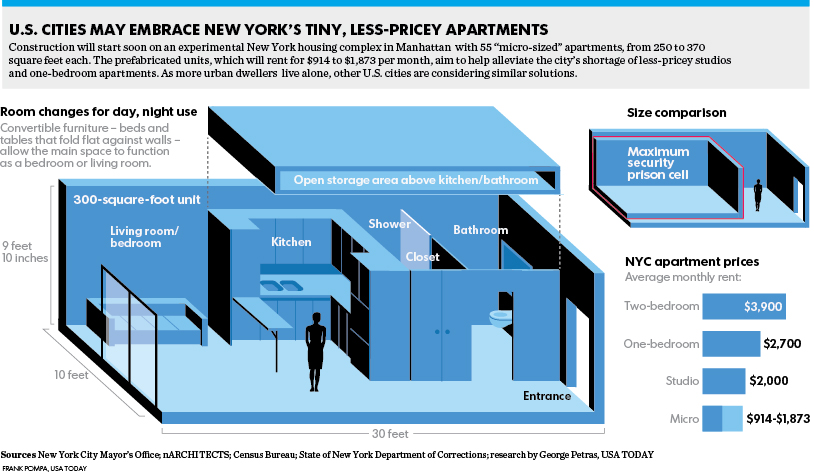
How Large is 300 Square Feet?

ny-tiny-apartments

I volunteered to do this graphic for USA Today after seeing Wendy Koch’s planned story on micro apartments in New York City. The idea behind the project is to provide low- to middle-income New Yorkers with decent living space at affordable prices. The idea may catch on in other U.S. cities.

I was intrigued by the architect’s dual-use plans for the apartments and wanted to show two things: 1) a common reference point for 300 square feet and, 2) how convertible furniture was used to change room functions.

I designed the graphic’s appearance and researched the information, and Frank Pompa, the artist, did his usual amazing job.

Link  to story:

http://www.usatoday.com/story/news/nation/2013/07/30/tiny-apartments-apodments-catch-on-us-cities/2580179/

Posted in Graphics | Leave a comment